Adventures in Alignment #2
Are your fill speakers phase compatible with your mains? Does it matter?
L-Acoustics K2 + dV-DOSC
Today I’m helping setup an L-Acoustics sound system at the convention center for an annual religious meeting. We’ve got K2 in the main array and dV-DOSC as delays.
The A1 aligned the system using distance measurements. Normally, I’m a big fan of this method. That’s what the 1:1 preset in SubAligner is for.
But today, I have some doubts. These speakers are 15 years apart. The dV-DOSC came out in 1999 and the K2 in 2014. Most manufacturers guarantee phase compatibility between speakers in the same family or generation, but these are not either.
After the event I took a look at some measurements from my library. Luckily, they’re compatible in the HF, where we need the most support as a fill speaker.


But they are 180º apart around 100Hz in the LF.

Is the LF important in this situation? Definitely not has important as the HF, but we don’t have any subs in the system so it would be a strong “nice to have”.
What can we do to handle this?
Normally, we would insert a second order all-pass on the dV-DOSC to make them wait for the K2 in the LF region.

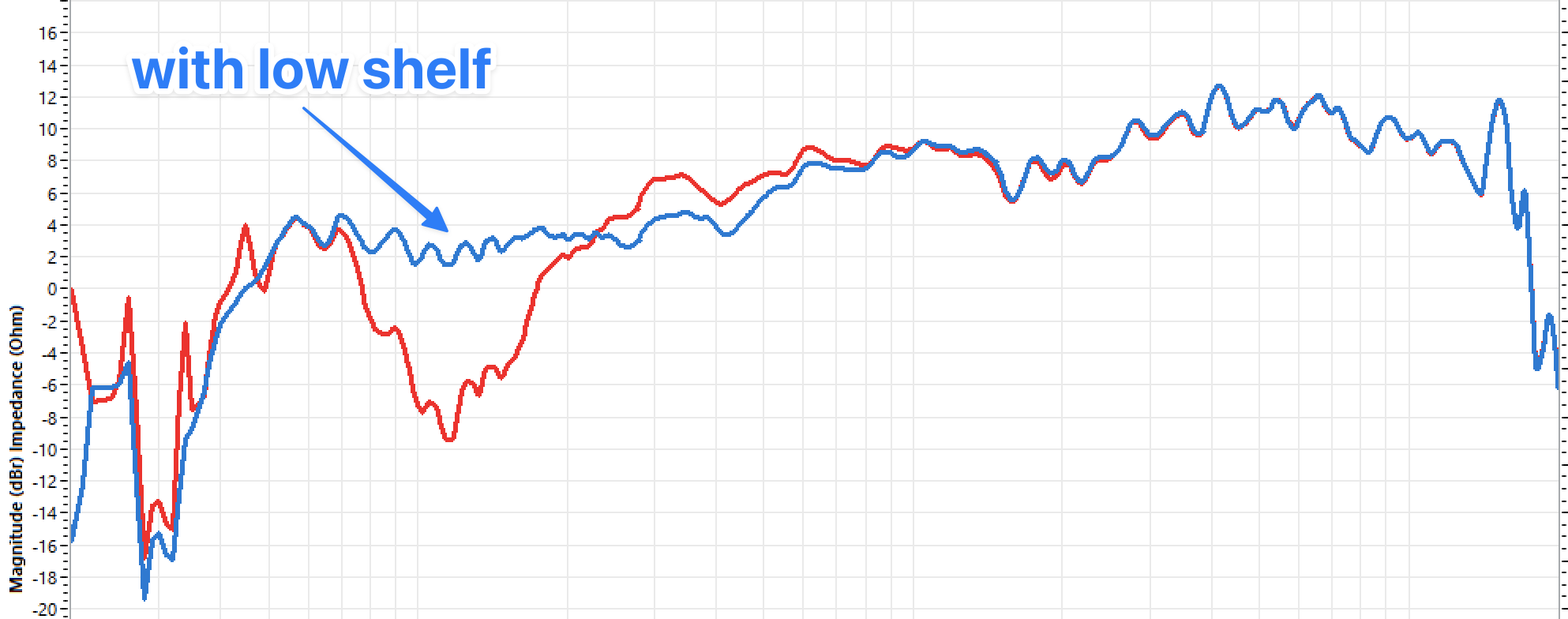
But L-Acoustics amps don’t give us access to all-pass filters. We could try to do some tricky parallel processing of a HPF and a LPF to get an APF, but what I normally do in this situation is just insert a low shelf on the delay speaker to reduce the interaction in the mis-aligned area.

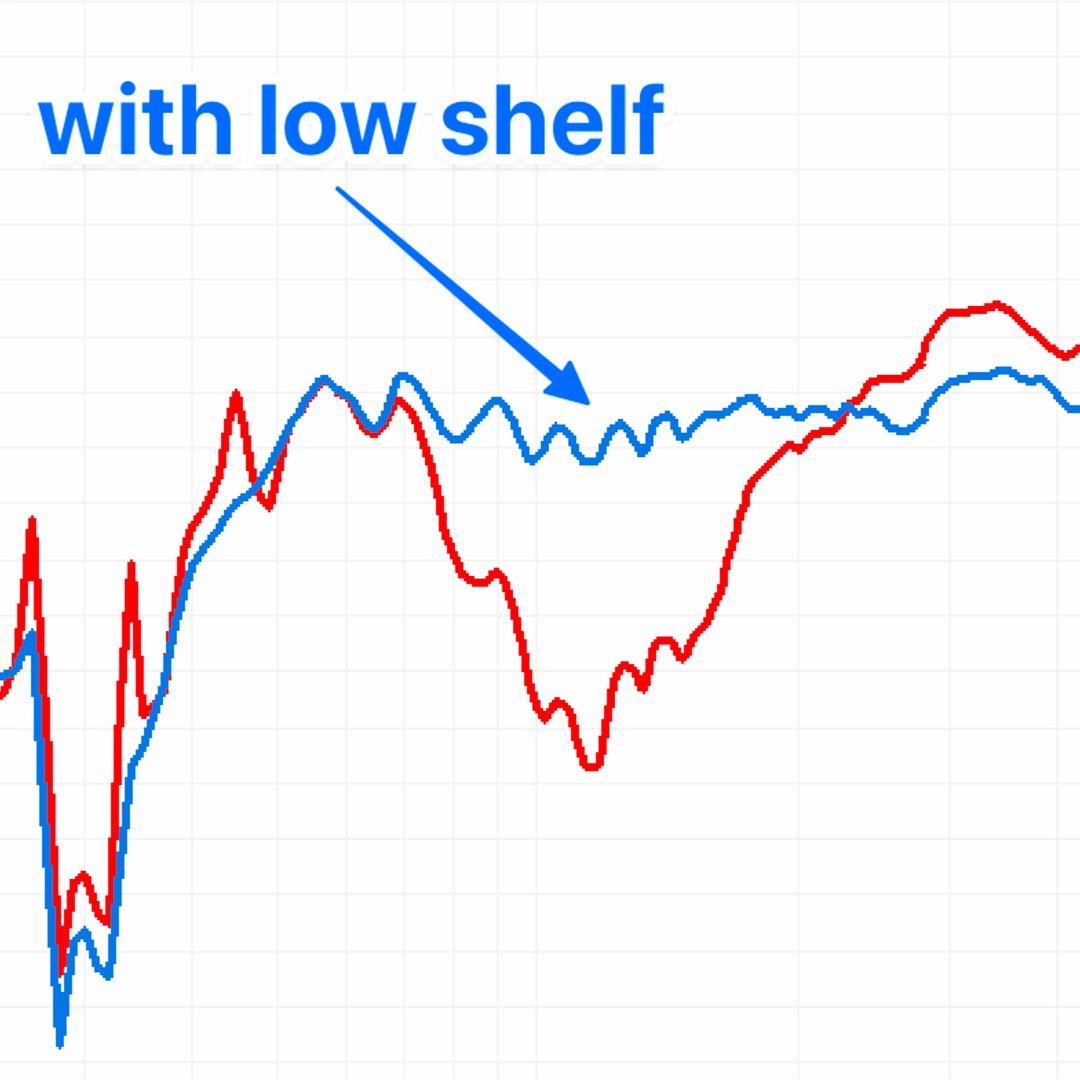
We end up with less overall energy in the LF, but a smoother response. This low shelf creates about +50º of phase shift around the cutoff frequency so we also get the added benefit of improve alignment in that area.

So here’s the final comparison of doing nothing vs doing something (low shelf).
JBL VRX 932-LAP + QSC K12
As old as they are, I still see these two loudspeaker models show up on lots of corporate events. Most recently it was on a small event in San Francisco.
In this case the A1 had estimated the path length difference to set the output delay. I showed him how to use SubAligner for more accuracy. But is that enough? Are they phase compatible?

Well that’s disappointing. Even when these two sources are time aligned and have similar phase slopes, the are not phase aligned. The stage is set for cancellation.
How could we have known?
We could have researched it ahead of time. I just looked up these measurements on Tracebook.
We could have also done listening tests and measurements in the field. Even so, how would we have solved it?
A first order all-pass filter at 500Hz might help, but how many output processors do you know of that offer this kind of filter?

Another option might be a polarity inversion and a high-pass filter.

There’s a better solution out there. These were just the first two I thought to try.
I feel like I have raised more questions here than I have answered, but it’s helping me think about where I want to go with SubAligner, which should be able to help with this exact problem. Currently it only offers spectral alignments (eg. main vs. sub), but my plan is for it to be able to align any source in its database, making it easy to align something like a K2 and dV-DOSC or VRX932 with a K12.
Have you run into this challenge in the field? How did you handle it?
Best practice?

On Instagram someone asked: “What is the recommended HPF and low shelving frequency for applications in system complements such as delay fill and front fills? Is the HPF set at 200Hz with a slope of 24dB/oct? How about the low shelving frequency at 2kHz for line arrays with 4 loudspeaker units?”
I can give you my recommendation, but I’ve never heard a global recommendation for applying filters to fill speakers.
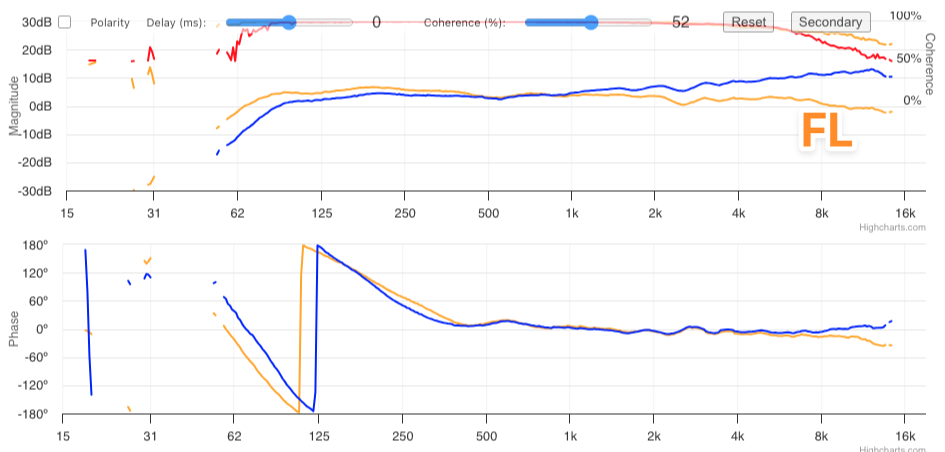
If there is any manufacturer recommendation, it is to load the proper preset. For example, in the preset guide for the JBL VTX V20 it says, “FL (FILL) = Preset nominal frequency response suitable for front fill use.” When you look at the magnitude response of these presets, it’s usually flat instead of the tilt up you commonly see on line array elements.
In Tracebook you can compare the V20 with the V20 FL preset to see the behavior I just mentioned.
I used to high-pass all of my fill speakers. This made sense to me to remove unnecessary LF and make it more efficient. What I didn’t realize is that filters create phase shift and many times I was unknowingly creating more problems than I was solving.
Imagine that you have a main system made up of line array elements and you decide to use the exact same element for front fill because you know that way they’ll be perfectly matched. Then you insert a HPF at 200Hz on the FF. Now it won’t sum with the main array in the LF and you’ll have a big dip in the combined response.
My recommendation: Do nothing, unless you’ve done your homework and you know what you’re doing.
- Study the transfer functions ahead of time. Practice applying filters to observe their effects. Check the manufacturer’s recommendations.
- Verify alignment in the field.